

.png)
For ownership groups managing commercial assets across multiple markets, leasing rarely receives the operational attention it deserves. Capital allocation, occupancy rates, and debt service tend to dominate the conversation. Yet when leasing processes are fragmented across assets, they quietly erode efficiency and complicate the metrics that drive portfolio performance. For owners serious about scaling, standardized leasing is not an administrative preference. It is a structural advantage earned through repeatable execution and cleaner data at every level of the portfolio.
Most ownership groups have accumulated leasing processes organically over time. A deal gets done one way in one market, another way in a different one. Templates are modified by local counsel, and negotiation protocols develop at the property level rather than the portfolio level. The result is a patchwork of documentation, approval chains, and execution timelines that vary asset by asset.
That variability carries real cost. When rent rolls differ in format, covenant language varies materially, or term definitions are applied unevenly, the downstream reporting burden multiplies. During refinancing events or portfolio transactions, inconsistent documentation introduces uncertainty into valuations that could otherwise be well-supported.
Consider an ownership group managing 15 assets across three regional markets, operating with six different lease templates and three distinct negotiation protocols. Deal velocity slows because each transaction requires a fresh review cycle. Portfolio-level reporting becomes a manual reconciliation exercise rather than a clean data pull.
Standardized leasing is often misunderstood as a push toward rigid, one-size-fits-all documentation. In practice, it is something more useful: a modular, rules-based system that enforces consistency in process while preserving flexibility in negotiation.
At its core, standardization encompasses four elements: master lease templates configurable by asset type or region, defined approval workflows with clear escalation paths, digital execution protocols that enforce consistent data capture, and structured outputs that feed cleanly into accounting and asset management platforms.
For asset managers, this framework creates portfolio-level transparency that is otherwise difficult to achieve. Legal teams benefit from reduced cycle times because foundational drafting work is already done. Accounting and operations teams receive lease data in consistent formats, reducing manual entry and improving the quality of financial analysis.
Standardization functions as a governance tool. It does not limit the ability to negotiate market-appropriate terms. It ensures that whatever terms are agreed upon are documented, approved, and recorded in a predictable, auditable way.
The efficiency gains from standardized leasing compound across every transaction in the portfolio. When templates are established and approval workflows are defined, legal review focuses on material deviations rather than routine drafting. Approval cycles move faster because decision-makers are evaluating a consistent structure rather than interpreting a novel one.
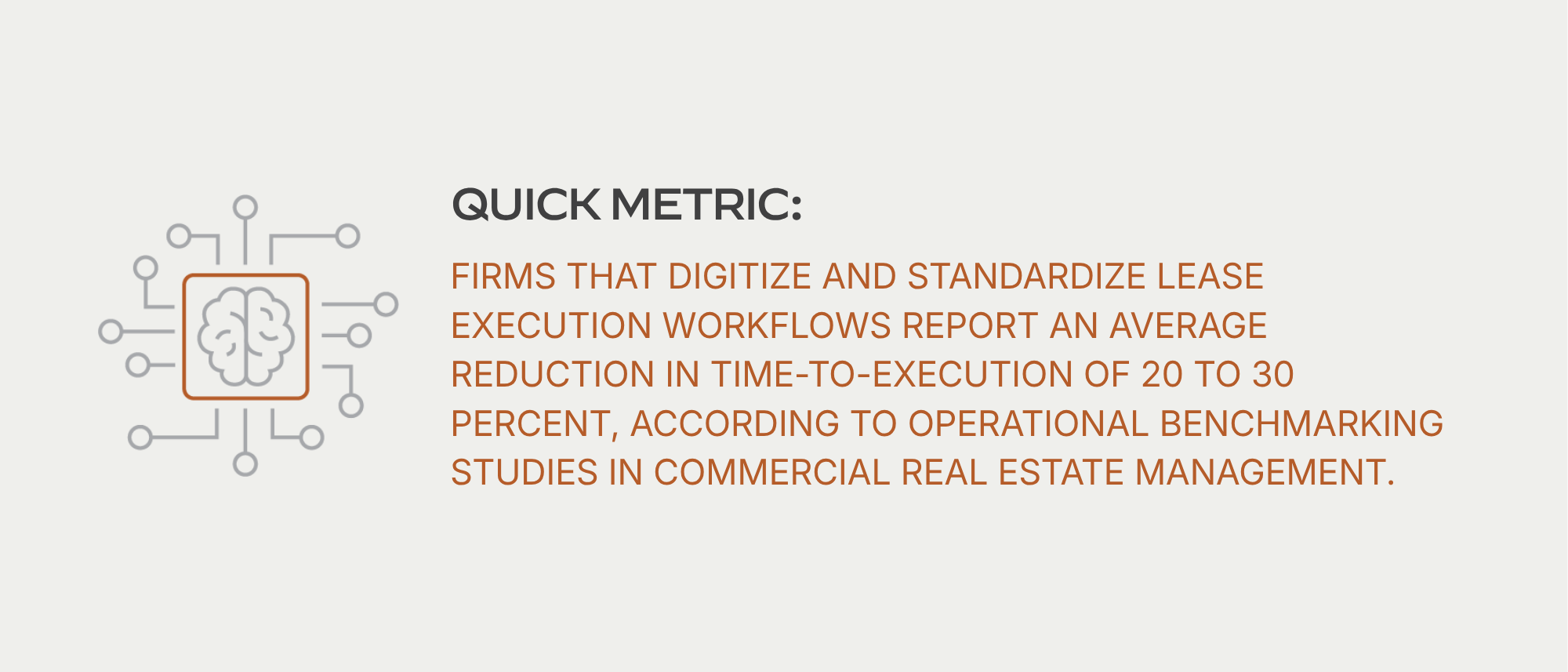
Industry data from comparable operational improvement initiatives in CRE suggest that organizations implementing standardized documentation and digital workflows can reduce legal review hours on routine leases by 35 to 45 percent. The time savings per transaction may appear modest in isolation, but across 200 active leases annually, the aggregate impact on internal resource allocation is substantial.
Standardization also simplifies the onboarding of new property managers and brokers. Rather than learning a property-specific process, incoming team members work within a defined framework from day one. Deal cadence improves, and the risk of process errors decreases proportionally.
To see these gains in practice, consider a portfolio of 20 suburban office and flex properties generating approximately 200 executed leases per year. Inconsistent templates across assets meant each lease required a line-by-line review regardless of complexity, pushing legal review times well above target benchmarks. By transitioning to standardized templates and a digital approval workflow through Nova Lease, the ownership group reduced internal legal time by 40 percent while retaining full flexibility for tenant-specific negotiation on material business terms.
The operational benefits of standardization are well-documented in adjacent industries. Less frequently discussed in CRE is the effect on portfolio intelligence and asset valuation.
When lease structures are consistent, the data they produce is comparable across the portfolio. Rent rolls can be analyzed as a unified dataset rather than reconciled property by property. Covenant terms can be stress-tested against market conditions with confidence that the underlying language means the same thing across assets. That comparability improves the quality of forecasting, sharpens risk assessments, and supports more credible benchmarking against market peers.
The valuation implications follow directly. Lenders and buyers apply tighter valuation spreads to portfolios where lease documentation is organized and consistent, because the due diligence required to verify income stability is materially reduced.
.png)
For ownership groups approaching a refinancing or disposition, standardized lease documentation allows lenders and buyers to verify rent roll consistency, confirm covenant uniformity, and assess term risk without extensive remediation. That preparation translates directly into execution efficiency at the transaction level.
Transitioning a portfolio toward standardized leasing does not require a wholesale overhaul. An incremental approach, applied thoughtfully, accommodates market-specific nuances and builds internal alignment through demonstrated results rather than top-down mandate.
A practical path forward involves five steps. First, audit existing templates and workflows across the portfolio to document the current state of variation. Second, identify recurring clauses and the points in the process where bottlenecks most commonly occur. Third, develop configurable master templates organized by use type or geographic region, allowing for local adaptation within a consistent framework. Fourth, digitize approval and execution workflows to enforce process consistency and create an auditable record. Fifth, establish a schedule for periodic legal and operational review so that standardization remains current over time.
Common barriers include legacy systems that do not support digital workflows, internal stakeholders accustomed to property-level autonomy, and legitimate concern that standardized forms will not capture local market nuance. A phased rollout addresses each of these by limiting early scope to asset types or markets where variation is highest and the efficiency case is easiest to demonstrate.
Standardized leasing does not constrain how an ownership group operates. It scales the capacity to operate consistently as the portfolio grows. The compounding benefit, measured in reduced legal hours, faster deal cadence, cleaner data, and stronger valuation support, positions standardization not as a back-office project but as a portfolio governance priority.
For owners ready to institutionalize their leasing infrastructure, Nova Lease provides the framework to move from fragmented execution to disciplined, scalable performance across every asset in the portfolio.